
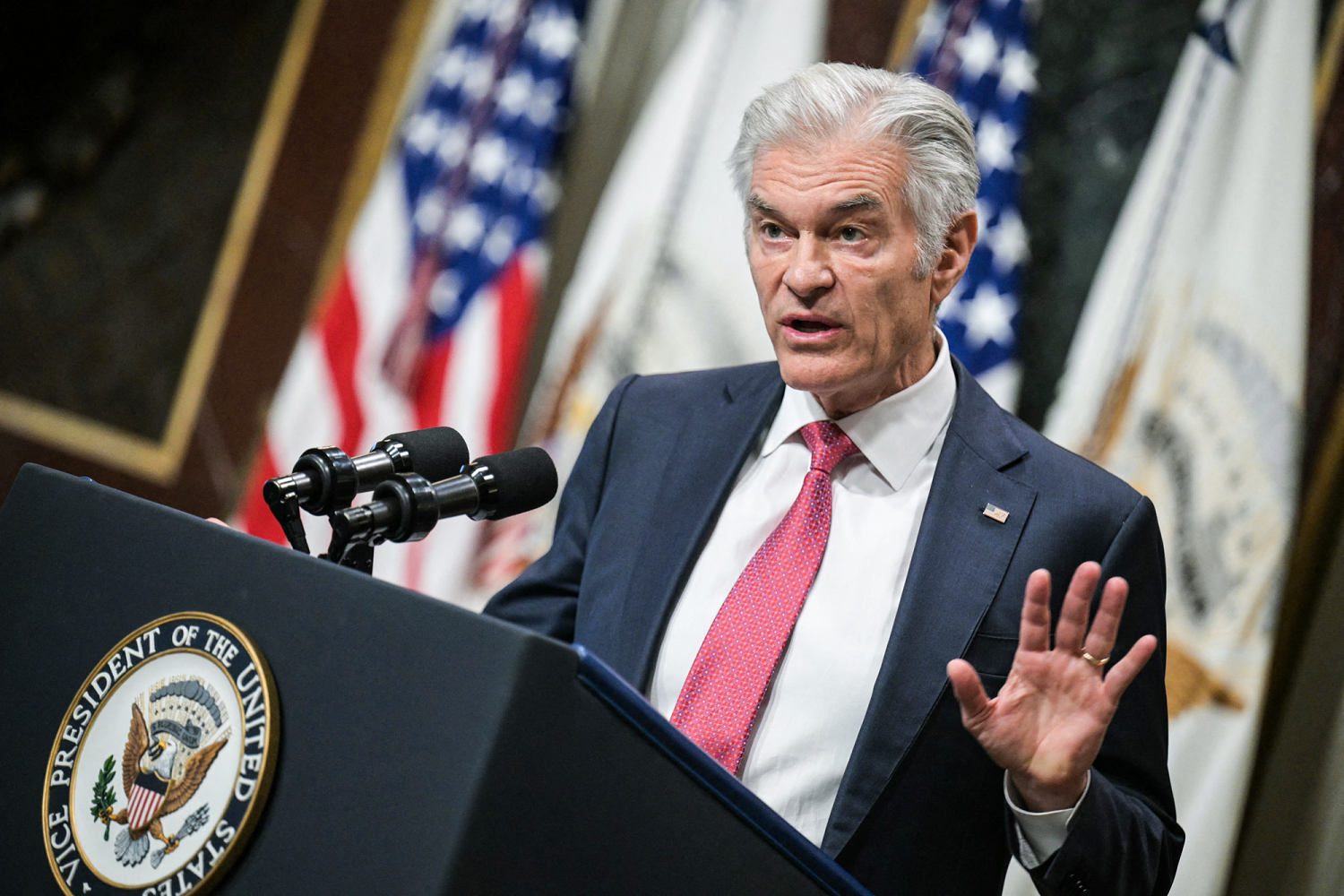
Although Obamacare sign-ups have fallen significantly this year over skyrocketing monthly premiums, Dr. Mehmet Oz believes enrollment is still too high. Oz, the Trump administration’s top official overseeing the Affordable Care Act, told NBC News that millions of people may be fraudulently enrolled or eligible for other types of coverage.
About 23 million people signed up for ACA coverage during this year’s open enrollment period, which ended in January, according to the latest data from the Centers for Medicare and Medicaid Services. That’s roughly 1.2 million to 1.3 million fewer sign-ups than last year. ACA coverage typically appeals to people who are self-employed or don’t get coverage through their jobs.
In a phone interview, Oz said some people enrolled in ACA plans should not be there and expects enrollment to fall further — to around 19 million.
“In fact, the fact that we have 23 million makes me think we have too many participants in the ACA,” Oz said. “It’s too high of a number.”
Oz believes some of ACA’s enrollment may stem from fraud in the sign-up process, as well as cases where people were enrolled by mistake, were signed up for duplicate coverage or received tax credits they didn’t qualify for. Others, he said, may qualify for Medicaid or could obtain insurance through a job but instead choose ACA plans.
Last year, the administration said 4 million to 5 million people were “improperly” enrolled in subsidized ACA coverage in 2024, costing U.S. taxpayers up to $20 billion. The administration cited the Paragon Health Institute, a conservative health policy think tank. The administration also pushed for a number of changes to the program, including changes to income verification and a shortened open enrollment period, moves it says are intended to maintain the ACA’s “integrity.”
“Either their income would not qualify them, they made too much or made too little, or they didn’t file the forms, maybe on purpose, or they were duplicately enrolled in Medicaid or more likely other states’ ACAs,” Oz said in the interview. “These are major concerns for us.”
“Fraud, waste and abuse” has been a mantra for Oz, who has claimed that communities in California and Minnesota are tied to health care fraud. Last month, Vice President JD Vance, joined by Oz, announced that the federal government would withhold $259 million in Medicaid funding for people in Minnesota due to concerns about fraud — a claim that Democrats said was politically motivated.
More on health insurance costs
Health policy experts say fraud exists across the entire health care system, but warn that the scale may not be as large as the administration suggests.
“Fraud is a real issue in the ACA marketplace and no one is disputing that,” said Cynthia Cox, director of the program on the ACA at KFF, a nonpartisan health policy research group. She said there are at least a few hundred thousand cases of fraudulent enrollment, not including fraud that may go unnoticed, but probably not millions.
“The scale of it may be overstated at times,” she added.
Richard Frank, a senior fellow in economic studies and director of the Center on Health Policy at the Brookings Institution, a nonpartisan think tank, said it’s likely “implausible” that 4 million to 5 million people, the number cited by the administration, are wrongly enrolled in the ACA.
“Obviously, the number is not zero, it’s not nothing,” Frank said. “But what people are calling fraud are very often just bookkeeping errors.”
The drop in ACA enrollment this year comes after Congress failed to extend the enhanced tax credits that kept premiums lower, leading to double-digit premium increases for millions of Americans. Some experts worried the higher costs would push more people to drop coverage or move to cheaper plans with higher deductibles — something state officials say they are already seeing.
Cheaper monthly bills, higher deductibles
Even as Oz argues that there are millions of Americans who should not be eligible for ACA plans, the administration is taking steps to bring more people into the program.
In February, the administration proposed changes to the ACA marketplace for next year, a move Oz said could bring younger and healthier Americans — people who are currently sitting out of the market and going uninsured — into the system.
The proposal includes raising the age limit for so-called catastrophic health plans.
Catastrophic plans are the lowest tier of ACA coverage, usually limited to people under 30 and offering low premiums but very high deductibles. According to KFF, the average annual deductible for a catastrophic plan in 2026 for an individual was $10,600 and $21,200 for a family.
Oz said he wasn’t sure whether CMS had publicly disclosed how high deductibles could go under the proposal, but he disputed an estimate reported by The New York Times that they could reach $31,000 for a family.
“How do I get people off the sidelines to participate in the ACA who otherwise wouldn’t?” Oz said. “So, right now, we’re leaving a lot of private sector people, the people working in the hot dog stand. They can’t afford to be able to join the silver plan.”
Cox, of KFF, said that while the proposal could bring more young, healthy people into the ACA, she worries it could also attract older adults and people with underlying health conditions who need more comprehensive coverage.
Health care literacy, Cox said, is low in the U.S. and some people may not understand exactly what they’re signing up for.
Frank echoed those remarks, saying that “people are not very good consumers of insurance.”
“They’re very complicated policies,” he said. “Even the high-deductible plans are really complicated. They have all kinds of bells and whistles around preventative care, about drugs, about vaccines.”
When asked about those concerns, Oz said that transparency will be important, adding that President Donald Trump’s “Great Healthcare Plan” calls for insurance companies to publish “plain English” summaries of their benefits.
Oz also argued that people are smart enough to make their own health care decisions.
“Most folks who are older, who have comorbidities, are not going to want the catastrophic plans for reasons that are self-evident,” he said.
