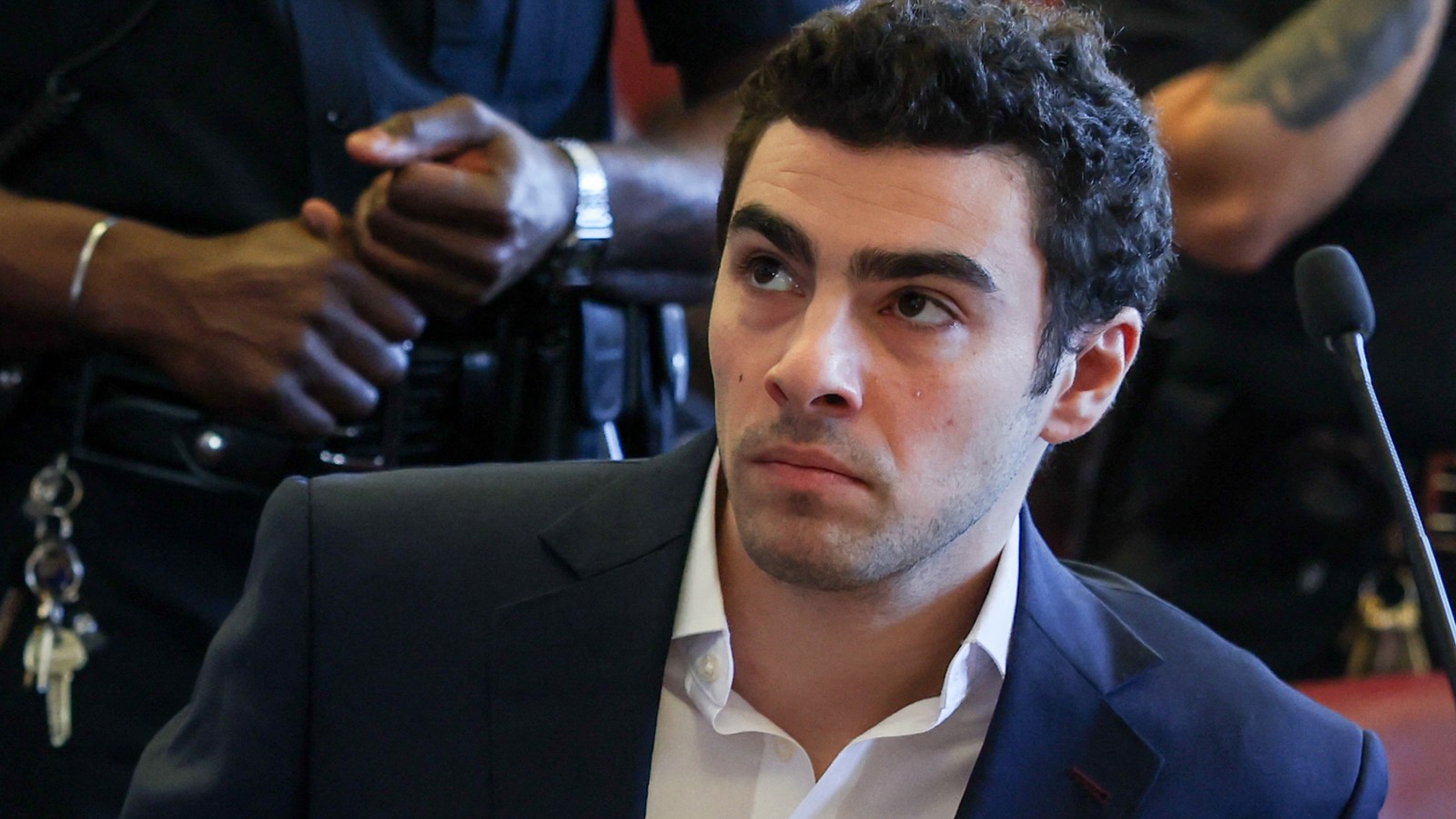
Luigi Mangione made rare public comments on Friday at New York State Supreme Court, after a judge declared his state murder trial will start in June, just months before his federal trial is set to begin. Mangione has been charged with stalking and murdering UnitedHealthcare CEO Brian Thompson, and faces multiple firearm charges. He has pleaded not guilty on all counts.
As he was being led, cuffed and shackled, out of the courtroom, Mangione turned to the gallery and spoke. “It’s the same trial twice,” he said firmly, surprising the audience since he has barely ever spoken in court before. “One plus one is two. Double jeopardy by any commonsense definition.”
Mangione’s remarks came after a tense pre-trial hearing in Manhattan where Justice Gregory Carro set a June 8 date for the state trial. Last month, Judge Margaret Garnett, who is presiding over the federal case, announced that the federal trial would begin in September of this year. (If the federal date changes, Carro said he would push the state trial to September.) Mangione faces murder and firearms charges in New York state and stalking charges in federal court. He also faces firearms and forgery charges in Pennsylvania.
Mangione’s defense team vehemently objected to the summer state trial date. “Mr. Mangione is being put in an untenable situation, because this is a tug of war between two different prosecution offices,” his lead defense attorney Karen Friedman Agnifilo told the judge on Friday. She said Assistant District Attorney Joel Seidemann “wants this case to go forward because he does not want the potential of his case being double jeopard-ied out because he did all the work on this case.”
Seidemann responded that if Mangione’s defense were to argue double jeopardy, they’d be “seeking to deprive the prosecuting agency on a local crime, a murder that happened in Midtown on our streets of a guest to our city.” He added that Brian Thompson’s family has asked federal prosecutors to let the state case go first.
After court, Friedman Agnifilo told the press, “Double jeopardy is meant to protect people, and they’re using it as a weapon here. It’s unfair.”
So what exactly is double jeopardy? And does it apply in Mangione’s cases?
Put simply, the double jeopardy clause of the Fifth Amendment is meant to protect a person from being prosecuted twice for the same offense.
According to lawyers who spoke with Rolling Stone, double jeopardy can’t officially come into play until someone has been convicted or acquitted of a crime. Meaning, if Mangione was found guilty in one trial, his team could argue double jeopardy to try and get the second indictment dismissed ahead of a second trial. Right now Mangione has not been convicted in any of his three cases.
And the double jeopardy protections come with nuances. For example, the “separate sovereigns doctrine” allows a federal and state court to prosecute the same defendant for the same act, if the act breaks both federal and state laws. This doctrine was used during the Civil Rights era; if a white defendant was found not guilty of murdering a Black victim in state court in the South, for example, he could still be tried for a civil rights violation in federal court.
Plus, if the crimes are considered “substantially different” and are distinguishable from one another, even if they come from the same act, they can still both be prosecuted. In this case, Mangione’s state charges are murder and firearms offenses and his federal charges involve “interstate stalking” which led to conduct that “caused the death” of Thompson.
“It’s not double jeopardy,” says attorney Catherine Christian, of Mangione’s two cases. Christian worked as a prosecutor at the Manhattan District Attorney’s office and is now a criminal defense lawyer. “But I would argue it too, if I was them.”
Christian says if she were Mangione’s defense attorney and he was convicted in state court, she’d immediately try to get the federal indictment dismissed. “I’d say, this is ridiculous, to go a block down [to federal court] and have this whole trial over again — which essentially is true, it would be — but it’s completely different charges. The same witnesses, the same criminal transaction, basically the same trial, but the crimes he’s being charged with federally just have different elements.”
New York defense attorney Lance Clarke agrees with Christian’s assessment of Mangione’s federal and state cases not amounting to double jeopardy even though they seem similar.
“Both cases arise from the same underlying events, but they are not identical,” says Clarke. “If the action itself is being litigated in both forms, but for different crimes, unfortunately that’s ok.”
Clarke explains that New York has some of the strongest statutory double jeopardy protections in the country, so Mangione’s defense might have a higher probability of getting the state case dismissed if federal goes first rather than vice versa. But nothing is certain.
Trial lawyer and legal analyst Richard Schoenstein says, in his opinion, Mangione has a strong double jeopardy argument should a second case go to trial after a conviction. But he also says he’s disappointed about the fact that the federal and state prosecutors didn’t coordinate about which trial should go first, which has the more significant penalty, better evidence, chance of getting a conviction, and who did the investigation.
“It’s absurd that they’re fighting about who goes first, and that is only because we’re in a world where politics rules prosecutor’s offices,” says Schoenstein. “The only reason the federal government sought the death penalty is because of politics. Because the federal administration is desperate to protect corporate executives. So if you kill one, you’re going to get the death penalty.” (The federal charges that would have carried a possibility of the death penalty were dropped on Jan. 30.)
He adds he thinks that Mangione’s team might have a good argument to appeal one of his convictions if they can argue that preparing for two trials simultaneously is overly burdensome.
Clarke and Christian also commented on how much work this will be for the defense to take on. Each prosecution team has one trial to prepare for, while the defense has two.
“It’s really, in my opinion, unfair,” says Christian. “A trial like this takes a lot of preparation. If the trial starts in June it probably carries over to July and then they’re supposed to start the other one in September. You can say it’s the same case but it really isn’t, it’s a completely different world.”
She adds, “Fair or not, judges can make you go to trial. You can protest all you want.”
On Friday, Friedman Agnifilo repeatedly told Carro that the defense would not be ready on June 8.
“Be ready,” he responded.
