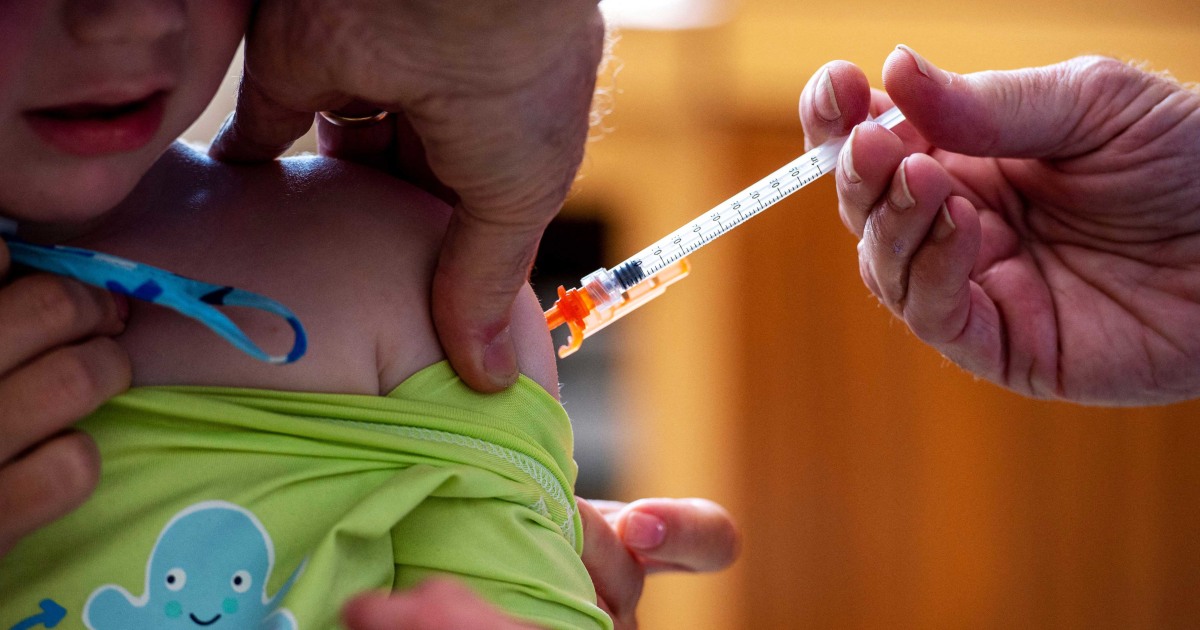
For parents of young children, visits to the pediatrician could involve new challenges and confusion now that the Centers for Disease Control and Prevention has drastically overhauled its recommended childhood immunizations.
The agency on Monday shortened the list of vaccines recommended for all children, dropping the number of diseases targeted from 18 to 11 — an unprecedented change that conflicts with guidance from medical groups like the American Academy of Pediatrics.
The new schedule separates vaccines into three categories: universally recommended shots, vaccines for high-risk groups and vaccines recommended based on shared clinical decision-making between patients and doctors. Covid and flu shots, for example, now fall into that third category, while infant RSV shots are only recommended for high-risk groups.
Many families are likely to have questions about which shots their kids are eligible for — with answers that are not always straightforward. The changes may require parents to track their children’s immunization schedules more closely, rather than relying on reminders from a pediatrician. The overhaul is unlikely to affect insurance coverage, however.
Here’s what parents should know, according to interviews with doctors, infectious disease experts, insurance companies and health policy experts.
How to know if a child meets the CDC criteria
Under the new CDC guidance, vaccines that target 11 diseases are still universally recommended: those for measles, mumps and rubella; pertussis, tetanus and diphtheria; chickenpox; polio; pneumococcal disease; HPV; and Haemophilus influenzae type B (Hib).
Recommendations changed, however, for vaccines targeting seven other diseases. Now, RSV shots are only recommended for high-risk groups. And the CDC says parents should consult with a health care provider about whether to get their child vaccinated for rotavirus, Covid and flu. Vaccines for hepatitis A and B, as well as for two types of bacterial meningitis, fall into both the high-risk and shared decision-making categories.
For many parents, these changes raise new questions: How do I determine if my child is in the high-risk category? And can I still ensure my child gets the shots that are subject to shared decision-making?

The answer to the second question is fairly straightforward: Any parent who wants their child to receive a particular shot should be able to get it as long as their doctor or pharmacist agrees to administer it. But for the first question, experts said it’s often challenging to determine a child’s risk level for an infection or illness — especially when it comes to RSV. Around 75% to 80% of infants hospitalized with RSV are otherwise healthy, with no underlying conditions.
“There is no way to stratify who’s at risk for RSV in this country,” said Dr. Yvonne Maldonado, a professor of global health and infectious diseases at Stanford University.
In the fine print of its overhauled recommendations, the CDC suggests an initial RSV dose for infants under 8 months if their mothers did not get an RSV shot while pregnant, and a second dose for children with underlying issues like chronic lung disease. That’s consistent with recommendations from the American Academy of Pediatrics.
Some doctors might not remind you about a child’s next shots
Many pediatricians still follow guidance from the American Academy of Pediatrics; if so, they are likely to note when your child is eligible for vaccines that are no longer universally recommended by the CDC, such as flu shots. Pharmacies will also continue to have reminders online and in stores, said Dr. Brigid Groves, vice president of professional affairs at the American Pharmacists Association.
But Dr. Jake Scott, an infectious diseases specialist at Stanford Medicine, said many doctors rely on an automated system that flags when a patient is due for a vaccine based on the CDC recommendations. The system does not flag vaccines that fall into the shared decision-making category, Scott said.
“It’s built for binary decisions — this patient needs this vaccine or they don’t,” he said. “It doesn’t have a pathway for, ‘Maybe. Discuss it.’”
That could put greater onus on parents to stay on top of their child’s immunizations.
Vaccine supply and availability may change
The altered vaccine recommendations could reduce demand for certain vaccines, which in turn might prompt some doctors’ offices to order fewer doses.
“I won’t be surprised if a lot of clinicians stop stocking the vaccines that are now under shared clinical decision-making,” Dr. Sean O’Leary, chair of the American Academy of Pediatrics’ committee on infectious diseases, said on a call with reporters on Monday.
Lower vaccination coverage raises the risk that viruses will circulate
Pediatricians worry that parents may assume, based on the new vaccine schedule, that certain lifesaving shots aren’t useful, and will opt their children out.
“The shift towards shared clinic decision-making will lead to dramatically lower uptake, and lower vaccine uptake leads to preventable illness and death,” Scott said.
Experts said the U.S. could see greater upticks in Covid or flu cases, or a resurgence of meningitis.
Immunocompromised children are sometimes less protected by certain vaccines or ineligible to get them. If some school districts choose to follow the CDC’s new schedule, it could mean more exposure to disease for these vulnerable kids, said Dr. Kelly Gebo, dean of the Milken Institute School of Public Health at George Washington University.
“I worry now that we’re entering a phase where we’re going to have different recommendations in different states, and it’s going to create chaos for children, for schools and for their parents,” she said.
Insurance should still cover vaccinations
The Health and Human Services Department said that private and federal insurance programs will continue to cover all vaccines recommended under the CDC’s previous childhood immunization schedule. Three major insurers confirmed to NBC News that such coverage would continue through the end of 2026.
Aetna said it is covering all vaccinations recommended by the CDC’s vaccine advisory panel as of Sept. 1, 2025, and Blue Cross and Blue Shield said it will keep covering the immunizations recommended by the panel as of Jan. 1. (The panel’s recommendation on Covid shots changed between those two dates.)
UnitedHealthcare said it will also continue to cover childhood vaccines. Its coverage policy relies on guidance from the American Academy of Family Physicians and American Academy of Pediatrics.
What to consider when making decisions with a health care provider
Other than avoiding a few tears at the doctor’s office, there’s no reason for kids to get fewer shots than were previously recommended by the CDC, experts said.
Health Secretary Robert F. Kennedy Jr. and others in the Trump administration have argued that children receive too many doses too early in life, and have drawn false links between early childhood vaccines and allergies or autism. However, experts say there are no safety concerns with the prior number of shots.
“The number of antigens — the immune stimulating proteins that children are exposed to through vaccines — is such a tiny, tiny fraction of what their immune systems encounter on a regular basis,” Scott said.
“The science hasn’t changed,” Groves said. “These vaccines are safe, they’re effective, and they prevent disease and death.”
Another new decision for parents: How many doses of the HPV shot should preteens get?
As part of its vaccine guideline overhaul, the CDC recommended that children ages 11 to 12 get one dose of the HPV vaccine instead of two or three.
Recent clinical trials have suggested that one dose may be as effective as two at preventing human papillomavirus, which causes cervical cancer. However, the AAP continues to recommend two doses for kids ages 9 to 12, or three doses for teens who haven’t started the series by age 15.
O’Leary said the American Academy of Pediatrics had been considering recommending one dose “for quite a while,” but that there should be a transparent process for changing any such guidance.
